
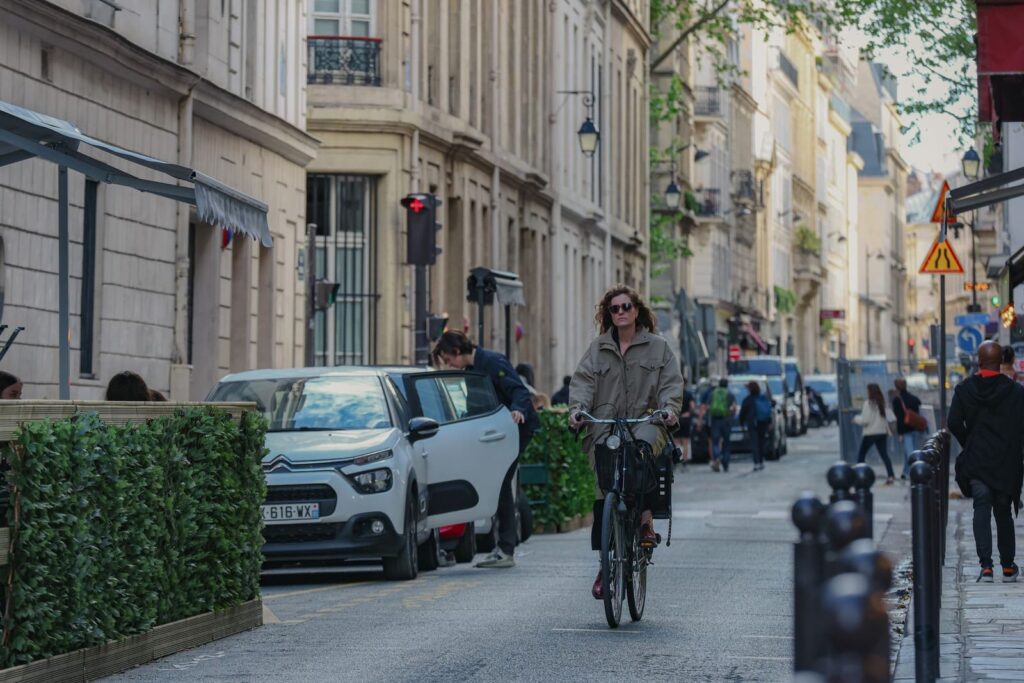
Few planning ideas have travelled as fast, or been as widely misunderstood, as the 15-minute city. In a few years it went from an academic proposal to a mayoral manifesto pledge in Paris, to a line in dozens of city strategies, to the subject of street protests in Oxford by people convinced it was a plan to fence them in. The idea itself is much plainer than either its champions or its opponents tend to suggest.
Where the phrase comes from
The term was coined by Carlos Moreno, a professor at the Sorbonne, in an opinion piece for the French business magazine La Tribune in 2016. His proposition was that most of the things people need in daily life, somewhere to live, work, buy food, see a doctor, learn and relax, should be reachable within about fifteen minutes on foot, by bicycle or by public transport.
It gained real momentum in 2020, when Anne Hidalgo made the “ville du quart d’heure” a central plank of her successful campaign for re-election as mayor of Paris. Since then Paris has been the reference case, and the concept has been adopted or adapted in cities as different as Melbourne, which plans around “20-minute neighbourhoods”, and Shanghai, whose 2016 master plan called for “15-minute community life circles”.
An old idea with a new name
Nothing in the concept would have surprised a Victorian Londoner, who had little choice but to live within walking distance of work, shops and school. The planning version has a long pedigree too. Clarence Perry’s “neighbourhood unit”, published in 1929 as part of the Regional Plan of New York, organised a residential area around a primary school within walking distance of every home, with shops at the edges. The post-war new towns in Britain used similar neighbourhood structures, and much of New Urbanism in the 1990s argued for the same thing.
What Moreno added was a framing aimed at climate and quality of life rather than at tidy land use diagrams. He describes the model in terms of four components: density, proximity, diversity and ubiquity. Put simply, enough people living close enough together, with a wide enough mix of services, spread evenly enough that every neighbourhood has them rather than a few favoured ones.
What it looks like on the ground
In Paris the programme has been less about new buildings than about making better use of what already exists. The best known measures include:
- School playgrounds opened as neighbourhood parks outside school hours, turning locked tarmac into green space within a few minutes of most homes.
- A large expansion of cycle lanes, including the conversion of general traffic lanes on major routes.
- Streets around schools closed to through traffic at the start and end of the day.
- Support for small shops and local services so that everyday errands do not require a trip across the city.
None of this is exotic. Most of it resembles things London boroughs have done piecemeal for years: school streets, low traffic neighbourhoods, protected cycle routes, community use of school sites. The 15-minute city is better understood as a way of checking whether those pieces add up to complete neighbourhoods than as a new programme in its own right.
What it is not
The concept attracted a remarkable amount of hostility in 2023. In February that year around 2,000 people marched in Oxford, carrying signs describing 15-minute cities as “ghettos” and instruments of “tyrannical control”. The protest merged two separate things: Oxfordshire’s traffic filter scheme, which limits private car trips through certain points at certain times, and the city’s local plan, which used 15-minute neighbourhood language to describe its aim of bringing services closer to homes.
The distinction matters. A 15-minute city is about proximity, putting more of what people need nearer to them. It does not by itself restrict where anyone can go, and there is nothing in Moreno’s model about confining people to their district. Traffic management schemes can be argued for or against on their own merits, but they are a different policy. Treating the two as one has made a sensible, fairly modest idea harder to discuss in Britain.
The genuine criticisms
That does not mean the concept is beyond challenge. The serious criticisms are about distribution and realism:
- Proximity is easier for the already well served. Central, dense, affluent neighbourhoods already come close to the ideal. Outer suburbs and low-density estates are furthest from it, and the investment needed to change that is large.
- Jobs rarely fit the model. Specialised work concentrates in centres. Very few people will ever work within fifteen minutes of home, which is why good public transport remains essential rather than optional.
- Local services need enough customers. A pharmacy, a GP surgery or a secondary school needs a catchment of a certain size. Without the density to support them, drawing fifteen-minute circles on a map does not make the services appear.
- Success can raise costs. Neighbourhoods that become more complete also become more desirable, and rising rents can push out the very residents and small businesses the policy was meant to serve.
How London measures up
London is in some ways the natural 15-minute city, a collection of former villages and market towns stitched together, many of which still have a high street at their centre. In much of inner London, a primary school, a food shop, a GP and a bus route are all within a short walk.
The gaps are in predictable places: large post-war estates designed without shops, outer boroughs where the car shaped development, and new housing built on former industrial land before the schools and surgeries arrived. That last point connects to a recurring theme on this site, the gap between permission and a spade in the ground. Homes get consented and built; the social infrastructure that would make the neighbourhood complete often lags years behind.
A useful question rather than a masterplan
The most practical way to use the idea is as a question applied to any place: what can people here reach in fifteen minutes without a car, and what is missing? Asked honestly, it tends to point towards unglamorous fixes, a surgery in a new development, a safe crossing to the school, a bus that runs in the evening, a corner shop allowed where the zoning forbids it. None of those restricts anybody. All of them make ordinary life a little easier, which is all the concept ever claimed to do.