
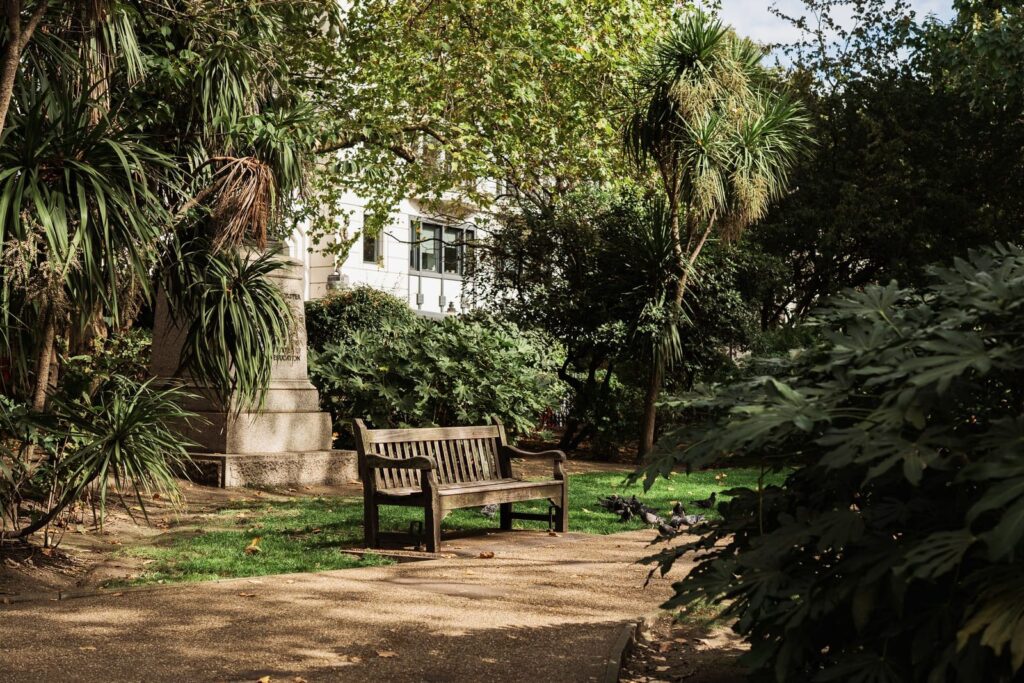
A pocket park is a public green space so small that it would not register on most maps. A former bomb site between two terraces, the leftover corner of a road junction, a churchyard opened to the public, a car park given back to trees and benches. Typically it occupies one to three building plots and is well under half a hectare. Nobody travels across the city to visit one.
That is precisely their value. Large parks serve a district and draw people from a distance. Pocket parks serve the few hundred people who pass them every day, and they do so at the moment of need: the ten-minute lunch break, the walk home from school, the pause on the way to the shops. For a great many Londoners, the green space they use most often is not Hyde Park or Victoria Park but a patch of grass and three benches at the end of their road.
A short history in one small garden
The idea of the small urban park grew in European cities rebuilding after the Second World War, where cleared sites were often turned into modest public gardens. It was then refined in the United States, and its best known example remains Paley Park in Midtown Manhattan, which opened on 23 May 1967.
Paley Park measures about 4,200 square feet, roughly 390 square metres, the size of a single townhouse plot on East 53rd Street. Designed by the landscape architects Zion and Breen and funded by the William S. Paley Foundation, it has a 20-foot waterfall across its back wall, a grid of honey locust trees and movable chairs. The waterfall does the essential work: its sound masks the traffic of Midtown, so that a few steps from the pavement the city seems to recede.
The sociologist William H. Whyte studied Paley Park closely for his 1980 book and film The Social Life of Small Urban Spaces. His conclusions, drawn from hours of watching how people actually used New York’s plazas, still read as a design brief for any pocket park.
What Whyte learned by watching
- People sit where there is somewhere to sit. The most used spaces simply had the most seating, and the best seating included steps, ledges and low walls as well as benches.
- Movable chairs matter. Being able to shift a chair a few inches, into the sun or out of it, towards a friend or away from a stranger, gives people a sense of control that fixed benches do not.
- Connection to the street is vital. Spaces sunk below or raised above the pavement, or hidden behind walls, were used far less than those visible and easy to step into from the street.
- People attract people. Contrary to what designers often assumed, people tended to sit near the flow of passers-by rather than retreat from it.
- Food helps. A kiosk or café at the edge of a space reliably increased its use.
Why small spaces punch above their weight
The benefits of urban green space are well documented, and several of them depend on proximity more than size. People use green space more often when it is close to home, and frequency of use is what drives most of the health and wellbeing effects.
There is also evidence that greening small neglected sites changes neighbourhoods directly. Research in Philadelphia, where the city cleaned and planted thousands of vacant lots, found reductions in crime around the greened sites. A later randomised trial there reported that residents living near greened lots felt markedly less depressed, with the largest improvements among people living below the poverty line. Philadelphia’s vacant lots are not London’s, but the finding is telling: modest, cheap interventions on small plots produced measurable effects on the people living beside them.
Small green spaces also do environmental work. Trees and planting absorb rainfall that would otherwise run straight into drains, provide shade on hot days and give birds and insects stepping stones between larger habitats. Individually each contribution is small. Across a borough with dozens of pocket parks, it adds up.
The London version
London has always had a rich supply of small green spaces, from Georgian garden squares to Victorian churchyards converted into public gardens, many of them in the City of London itself. In the 2010s the Mayor of London ran a dedicated pocket parks programme that funded boroughs and community groups to create or improve small spaces across the city, often on sites that had been car parks, verges or unloved corners.
The most interesting recent examples come from street space itself. Where a borough closes a side road to through traffic, the section of carriageway at the closure point often becomes the most practical new green space in the neighbourhood: planters, a bench or two, a tree, sometimes cycle parking. These are pocket parks by another name, and they cost far less than buying land.
Why some fail
Not every small green space works. The common failures are predictable:
- Nowhere to sit, often because seating was removed to deter rough sleeping or anti-social behaviour. The result is usually a space that nobody uses at all.
- Hidden from the street, behind high railings, hedges or level changes, so that it feels private or unsafe.
- No maintenance budget. A pocket park is cheap to build and depends entirely on regular care. Without it the planting dies, the bins overflow and the space becomes the eyesore it replaced.
- Wrong location. A space away from any flow of people will stay empty however well designed it is.
Making the case
For anyone arguing for a pocket park, the strongest case is rarely ecological or aesthetic. It is about everyday use. Count the people who walk past the site in an hour at lunchtime and at school closing time; note the nearest bench, the nearest shade and the nearest public green space; then show what a few hundred square metres could do for those people.
Councils are under intense pressure on maintenance budgets, so the most successful schemes usually arrive with a plan for looking after them: a friends group, a local business willing to sponsor the planting, or a housing association taking responsibility as part of a nearby development. A small park that is looked after will be loved for decades. One that is not will be fenced off within five years.