
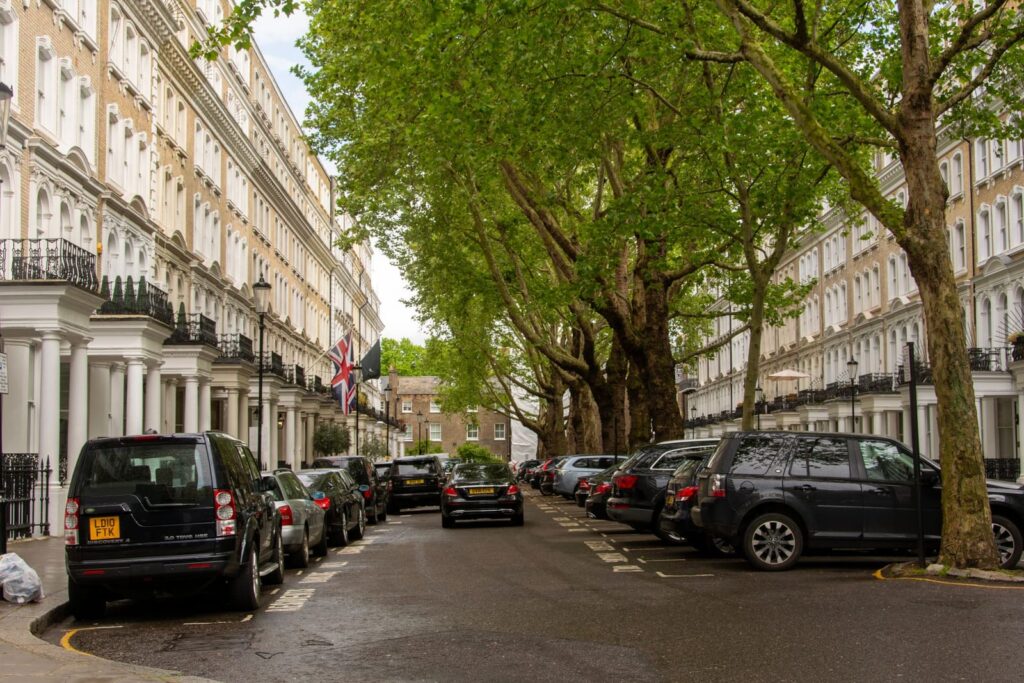
A street tree is one of the few pieces of public infrastructure that becomes more valuable every year it survives. A lamp post, a bench or a paving slab starts depreciating the day it is installed. A plane tree planted outside a terrace in the 1880s now shades the pavement, cools the houses, catches rainfall, filters the air and props up the value of every home on the street, and it does more of each than it did fifty years ago.
That asymmetry is at the heart of every argument about street trees. The benefits are large, slow to arrive and spread across everybody. The costs are immediate, specific and land on a particular budget. Understanding who pays and who gains is the key to understanding why cities that say they love trees still struggle to plant and keep them.
The London plane, and why it is everywhere
Walk down almost any older street in central London and the tree above you is likely to be a London plane. It is a hybrid of the oriental plane and the American sycamore that arose in the seventeenth century, and it was planted extensively in Victorian London for a practical reason: it tolerated the smoke and soot of the industrial city and coped with compacted soil under pavements. Its bark flakes away in patches, which is often said to have helped it cope with the grime, and it grows into a very large tree. Some of the oldest in the capital, in Berkeley Square, were planted in 1789.
Its dominance is also a vulnerability. A tree population heavily reliant on one species is exposed to any pest or disease that targets it, which is why tree officers now plant a much wider range of species on London streets.
What trees actually do for a street
- Cooling. Shade and evaporation from leaves lower surface and air temperatures. On a hot afternoon the difference between a shaded and an unshaded pavement is obvious to anyone walking it, and in heatwaves that difference matters for health, particularly for older people.
- Rainwater. Canopies intercept rain and tree pits absorb it, reducing the volume and speed of water reaching drains during heavy storms. In a city with an old combined sewer system, that is a real service.
- Air quality. Leaves capture fine particles, and the plane is among the more effective species at doing so. Trees are not a substitute for reducing emissions, and in narrow, enclosed streets a dense canopy can trap pollution at ground level, so species and placement matter.
- Walking and wellbeing. Tree-lined streets are more pleasant to walk along, and people choose them. Shade and greenery are among the comfort factors that decide whether a short trip is made on foot.
- Property values. Homes on tree-lined streets generally sell for more than comparable homes on bare streets, an effect found in studies in many countries.
- Wildlife. Street trees link parks and gardens into corridors that birds, bats and insects use to move across the city.
What they cost
The costs are less discussed and more concrete. Planting a young tree in a pavement is not a matter of digging a hole. Utilities run under most footways, and a new tree pit often has to be positioned around gas mains, water pipes, fibre and electricity cables. Where soil is poor or space is tight, engineered tree pits with structural soil or cellular systems give roots room to grow without lifting the paving, and those cost much more than the tree itself.
Then come watering in the first two or three summers, when most failures happen, formative pruning, regular inspections, and the management of problems that grow with the tree: roots lifting paving, branches over carriageways, subsidence claims on clay soils. London sits largely on clay, and insurers’ claims that trees have caused subsidence to nearby houses are a steady pressure on councils to fell or heavily prune mature trees.
Who pays
In most of London, street trees belong to and are maintained by the borough as highway authority, and funded from highways or parks budgets that are under constant strain. The benefits, by contrast, accrue to the health service through cooler, healthier residents, to the water company through reduced storm flows, to homeowners through higher values and to everyone through a more pleasant city. None of those beneficiaries writes the cheque.
Several approaches try to close that gap:
- Asset valuation. Methods such as CAVAT, developed by London tree officers, put a monetary value on individual trees so that a mature tree is treated as a public asset rather than a liability, and developers or utilities who damage one can be asked to compensate for its full value.
- Planning obligations. New developments can be required to plant and establish street trees, or to fund them, as part of their permission.
- Sponsorship. Several boroughs and charities allow residents and businesses to pay for a tree outside their home or shop, with the council planting and maintaining it.
- Tools like i-Tree. Developed by the United States Forest Service, i-Tree estimates the ecosystem services that a city’s trees provide, which gives councils figures they can put in front of budget holders.
A warning from Sheffield
What happens when the maintenance logic runs one way and residents’ values another was shown vividly in Sheffield. In 2012 the city signed a 25-year highways maintenance contract with Amey worth £2.2 billion, and the programme that followed felled thousands of street trees, around 5,000 by August 2017, many of them healthy. Protests grew, the felling was paused in 2018, and in 2019 the council apologised and acknowledged it had got things wrong. A new street tree partnership strategy followed in 2021, and in 2022 the city was named a Tree City of the World.
The lesson is not that trees can never be removed. Sometimes they must be. It is that a tree’s value has to be counted properly before the decision is made, and that residents who have lived under a tree for decades will not accept a spreadsheet that treats it as a trip hazard.
Getting it right
The streets that keep their trees share a few habits. They plant the right species in the right place, with enough rooting space. They budget for watering and aftercare, not only for planting. They value mature trees as assets and protect them during building works. And they involve residents, who are usually the first to notice a tree in trouble and the most willing to help look after it. None of this is expensive compared with what a street full of mature trees returns over a century.